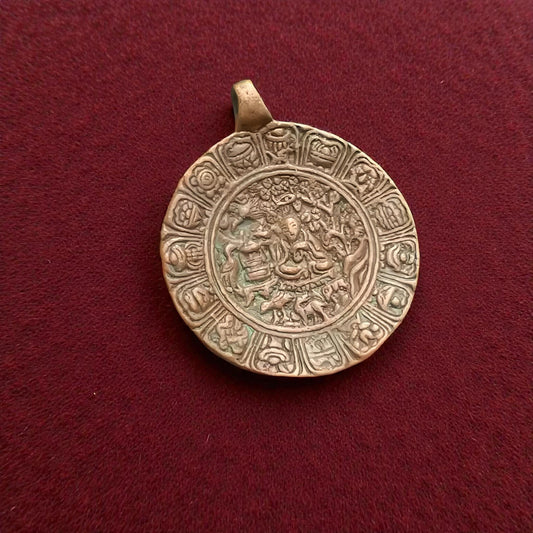
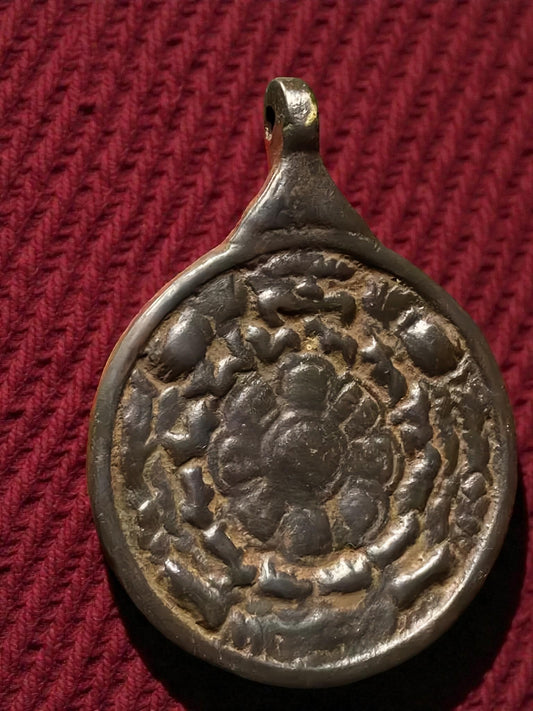
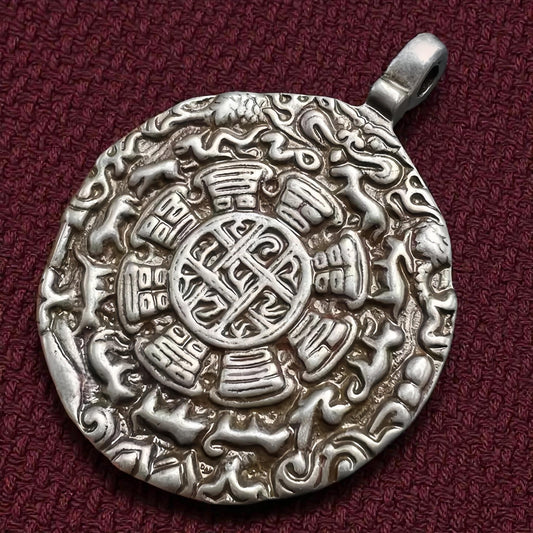
Tibetan Buddhist art carries a working vocabulary of symbols — motifs that repeat across textiles, metalwork, painting and jewellery, each with a settled meaning. This collection gathers the symbolic forms we carry: the eight auspicious symbols, the endless knot, the dharma wheel, the nine-palace chart, mandala plates and the protection motifs.
The eight auspicious symbols are the endless knot, the lotus, the treasure vase, the pair of golden fish, the victory banner, the right-turning conch shell, the precious parasol and the dharma wheel. They are frequently drawn as a set, and a single object may carry several at once. The endless knot is the most common in jewellery, where its interwoven line suits a flat pendant.
Protection motifs: the vajra (dorje), the phurba and written mantras appear across ritual objects and wearable pieces. The vajra signals indestructibility; the phurba is the dagger form used to pin down obstruction. Both have their own collections if you want to look at those forms on their own.
Reading a motif in a photograph: look at the outline first — a circular wheel, a woven knot and a triangular dagger read very differently at a distance. Then look at the interior, where the detail that identifies a specific symbol usually sits. On metal the motifs are often raised or engraved, and angled light makes that relief far easier to read.
What we describe and what we do not: we describe what the photographs show — outline, motif, proportion, surface and finish. We do not state materials, age or ritual suitability we have not confirmed, and we do not present an object as consecrated or as producing a particular effect.
Where to go next: our guide to Tibetan sacred symbols covers the meanings in full, including sections on the endless knot and the dharma wheel. For the objects themselves, see Pendants and Ritual Tools.
Each listing records its own measurements and finish — compare the size-reference photographs before choosing.