
What Is a Prayer Wheel? Meaning, Placement, and Daily Presence

A form built for movement
A prayer wheel is one of the most recognizable Tibetan ritual forms, yet many people first encounter it simply as a visually striking object. That first impression is understandable. A prayer wheel has rhythm in its silhouette, relief in its surfaces, and a strong sense of movement even while standing still. But its value is not only visual. It carries devotional meaning, repetition, and symbolic continuity.
Part of the reason prayer wheels work so well in domestic interiors is that they feel complete even when they are not being used. A small wheel on a shelf, desk, or altar can bring a room a center of gravity. It suggests reflection, continuity, and a more measured pace. For customers who want an object that feels spiritual without becoming theatrical, the prayer wheel often becomes a natural starting point.
Placement on an altar, desk or shelf
Placement matters. On a home altar, a prayer wheel usually works best when it has a stable surface and enough clear space around it. On a desk or shelf, it can act as the visual anchor that gives smaller objects meaning. It does not need to dominate the room. It only needs to feel deliberate.
How material changes its mood
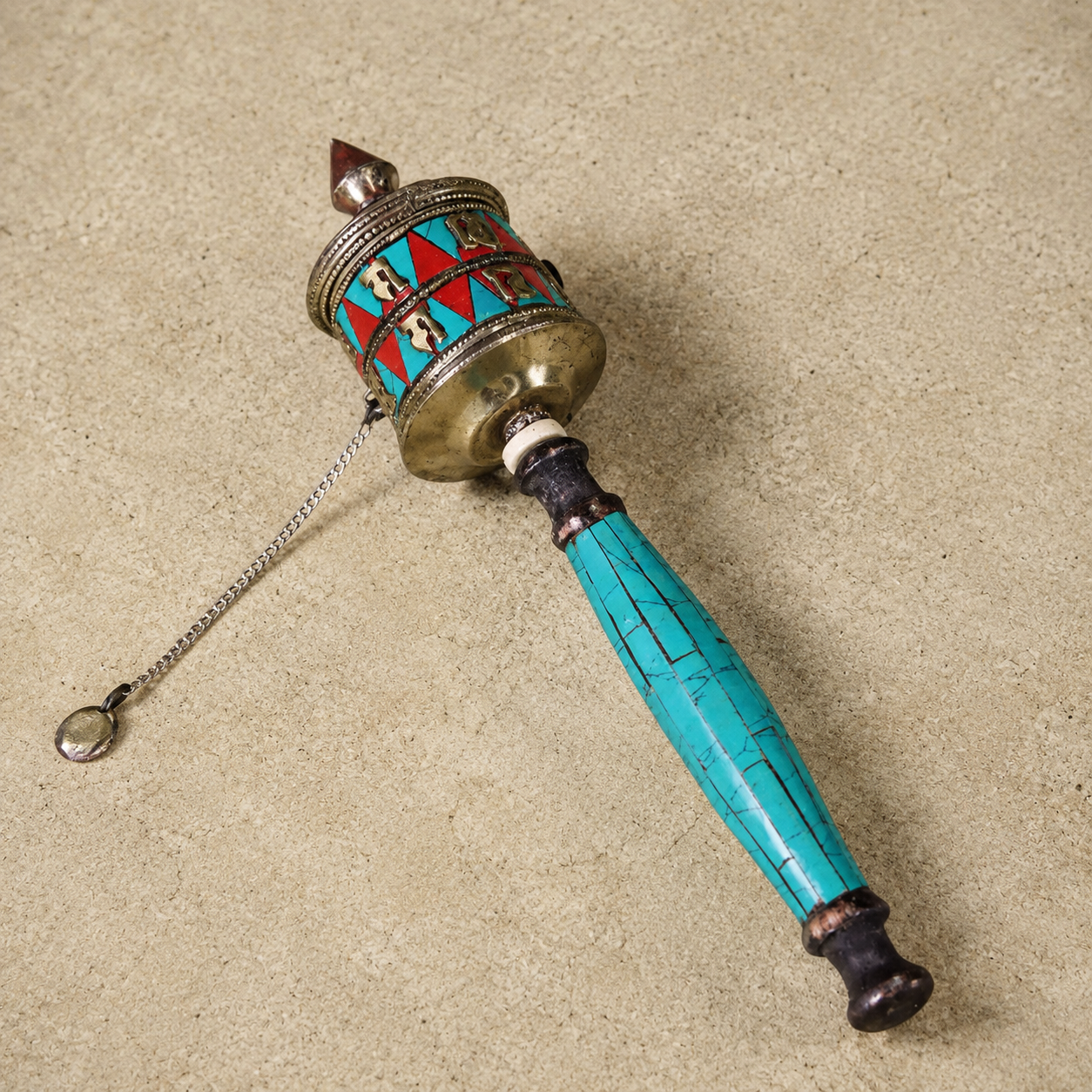
Material changes its mood. A bright metal wheel can read as more ceremonial, while aged brass, copper tones, or turquoise inlay can make it feel warmer and more domestic. The strongest pieces do not look like props. They look like objects chosen to be lived with.
Does it belong in your space?
If you are deciding whether a prayer wheel belongs in your space, the useful question is not whether it is decorative enough. The better question is whether it deepens the room’s sense of symbol, steadiness, and ritual presence. When it does that, it belongs.
Wheel, cylinder and axis
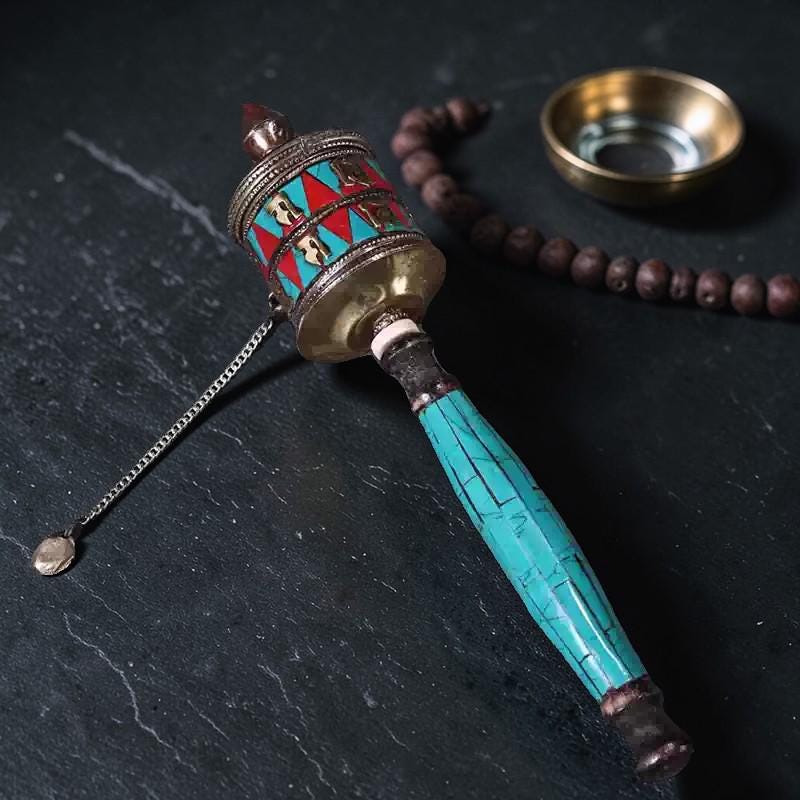
A prayer wheel is built around a cylinder that turns on an axis. The weight sits in the body of the cylinder, which is why a balanced wheel feels steady in the hand rather than top-heavy. Look at where the axis meets the top and the base: that is the part that decides whether the motion feels smooth or gritty.
Some wheels are made to be turned by hand, while others are meant to hang or stand. If you plan to turn it, check that the surface has room for a full rotation. If it is going on a shelf, the axis and the base matter most, because the piece will be judged standing still.
Care and handling
Keep the cylinder dry and free of dust around the pivot. A soft dry cloth is enough for the outer surface; avoid soaking the piece or using liquid polish on inlaid areas, where residue can collect in the recesses.
If the wheel stops turning freely, it is better to stop than to force it, since the axis is the most delicate part of the form. For display, a piece that no longer turns can still hold its place as an object — many are kept for the silhouette and surface rather than for the motion.
Related pieces in the collection: the Turquoise-Inlaid Prayer Wheel | Copper Decorative Collectible and the Prayer Wheel Hanging Ornament, Mani Decor. Browse the wider collection for more.